By Roland Pihlakas
Much of AI safety discussion revolves around the potential dangers posed by goal-driven artificial agents. In many of these discussions, the agent is assumed to maximise some utility metric over an unbounded timeframe. This simplification, while mathematically convenient, can yield pathological outcomes. A classic example is the so-called “paperclip maximiser”, a “utility monster” which steamrolls over other objectives to pursue a single goal (e.g. creating as many paperclips as possible) indefinitely. “Specification gaming”, Goodhart’s law, and even “instrumental convergence” are also closely related phenomena.
However, in nature, organisms do not typically behave like pure maximisers. Instead, they operate under homeostasis: a principle of maintaining various internal and external variables (e.g. temperature, hunger, social interactions) within certain “good enough” ranges. Going far beyond those ranges — too hot, too hungry, too socially isolated — leads to dire consequences, so an organism continually balances multiple needs. Crucially, “too much of a good thing” is just as dangerous as too little.
This post argues that an explicitly homeostatic, multi-objective model is a more suitable paradigm for AI alignment. Moreover, correctly modelling homeostasis increases AI safety, because homeostatic goals are bounded — there is an optimal zone rather than an unbounded improvement path. This bounding lowers the stakes of each objective and reduces the incentive for extreme (and potentially destructive) behaviours.
Homeostasis — the idea of multiple objectives each with a bounded “sweet spot” — offers a more natural and safer alternative to unbounded utility maximisation. By ensuring that an AI’s needs or goals are multi-objective and conjunctive, and that each is bounded, we significantly reduce the incentives for runaway or berserk behaviours.
Such an agent tries to stay in a “golden middle way”, switching focus among its objectives according to whichever is most pressing. It avoids extremes in any single dimension because going too far throws off the equilibrium in the others. This balancing act also makes it more corrigible, more interruptible, and ultimately safer.
There are two distinct types of balancing involved:
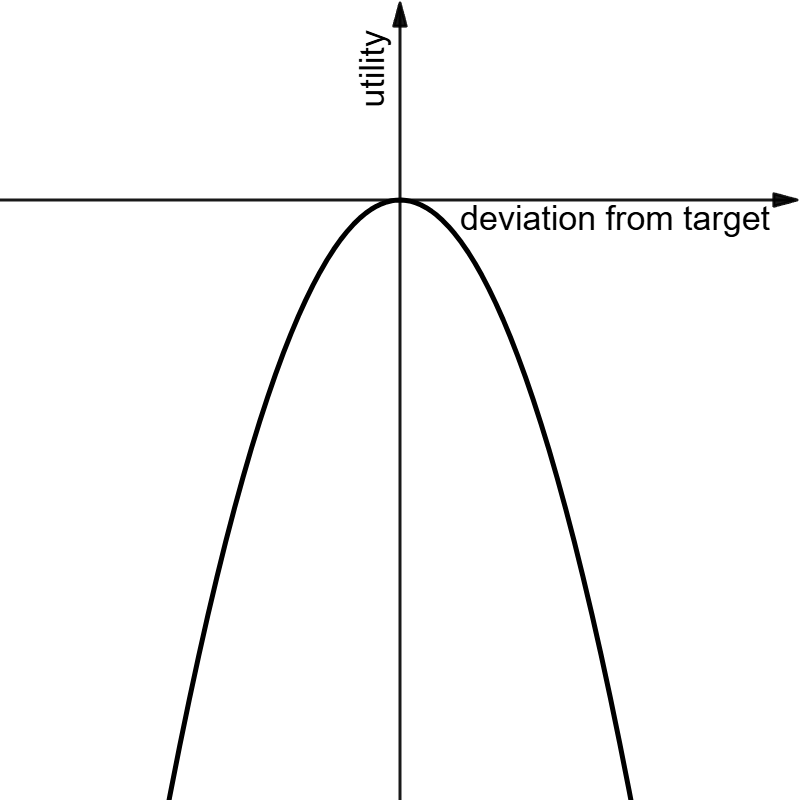
1. Balancing of a single homeostatic objective - keeping the actual value not too low, not too high.
2. Balancing across objectives.
In short, modelling multi-objective homeostasis is a step toward creating AI systems that exhibit the sane, moderate behaviours of living organisms — an important element in ensuring alignment with human values. While no single design framework can solve all challenges of AI safety, shifting from “maximise forever” to “maintain a healthy equilibrium” is a crucial part of the solution space.
Figure 1: Utility function of a homeostatic objective: